Blanchard Doesn't Have One Housing Market. The County Line Splits It in Two.
August 13, 2026
August 13, 2026
Search for Blanchard's home values this spring and you'll find three answers that don't agree with each other. One national index puts the average home value at $321,839 as of April 2026, up 2.8% over the past year, with homes going to pending in around 44 days. A different algorithmic estimate calculates a median sale price closer to $356,500 for March 2026, a jump of nearly 30% year over year. A third widely cited figure lands closer to $330,000. Same city, same few months, three different stories.
None of these numbers is wrong. They're just describing different halves of the same town. Blanchard is not one housing market wearing one median price. It's two markets, split by a county line that runs straight through the city itself, and that line changes the tax bill, the water source, and even whether a given lot can legally carry a septic system.
Blanchard was platted in 1906 by the Canadian Valley Construction Company as a stop on a rail line that changed hands twice before the Atchison, Topeka and Santa Fe Railway finished it. The town grew up around that rail line in what is now northwestern McClain County. But Blanchard's city limits extend west into Grady County, and they have for as long as the town has existed. The city covers roughly 30.44 square miles of land and an estimated 9,663 residents as of 2023, spread across a boundary that most buyers never think to ask about until it shows up on a title commitment.
The detail that makes Blanchard unusual in its own backyard is that neither of its Tri-City neighbors has this problem in the same way. Newcastle sits inside McClain County. Tuttle sits inside Grady County. Blanchard is the one town in the trio whose own city limits run through both counties at once, which means a buyer comparing all three towns has to ask a question in Blanchard that Newcastle and Tuttle don't raise on their own.
That boundary means two different county offices are pricing the same city.
| McClain County side | Grady County side | |
|---|---|---|
| Assessor's office | Purcell (county seat) | Chickasha (county seat) |
| Typical annual tax bill | Around $2,000, roughly 5% above the McClain County average | Set by a median effective rate near 1.15% |
| How that compares | County-specific average | Higher than Oklahoma's 0.90% statewide median and the 1.02% national median |
| Appeal window | Filed through the McClain County Assessor | Valuation notices go out in February or March, with the Board of Equalization reviewing appeals from roughly April 1 through May 31 |
The Grady County Assessor's office and the McClain County Assessor's office don't coordinate on reassessment schedules, exemption paperwork, or appeal deadlines, because they're separate elected offices answering to separate county governments. A buyer who assumes their closing statement will look like their neighbor's, three doors down, is assuming the neighbor is taxed by the same county. On a boundary street in Blanchard, that assumption is often wrong.
This is the part that actually explains the conflicting numbers from the top of this post. A home price index doesn't know or care which county a sale closed in. It averages whatever sold that month. When a run of tight subdivision lots on municipal water closes in one stretch, the median leans one way. When a cluster of acreage resales on private wells closes the next month, on the Grady side, the median swings the other way, not because the market moved, but because the mix of what sold moved.
That's the honest explanation for why one index shows a $321,839 average with modest 2.8% growth while another shows a $356,500 median jumping nearly 30% in the same season. They aren't disagreeing about Blanchard's value. They're each averaging a different blend of a market that is genuinely two different products stapled together under one city name.
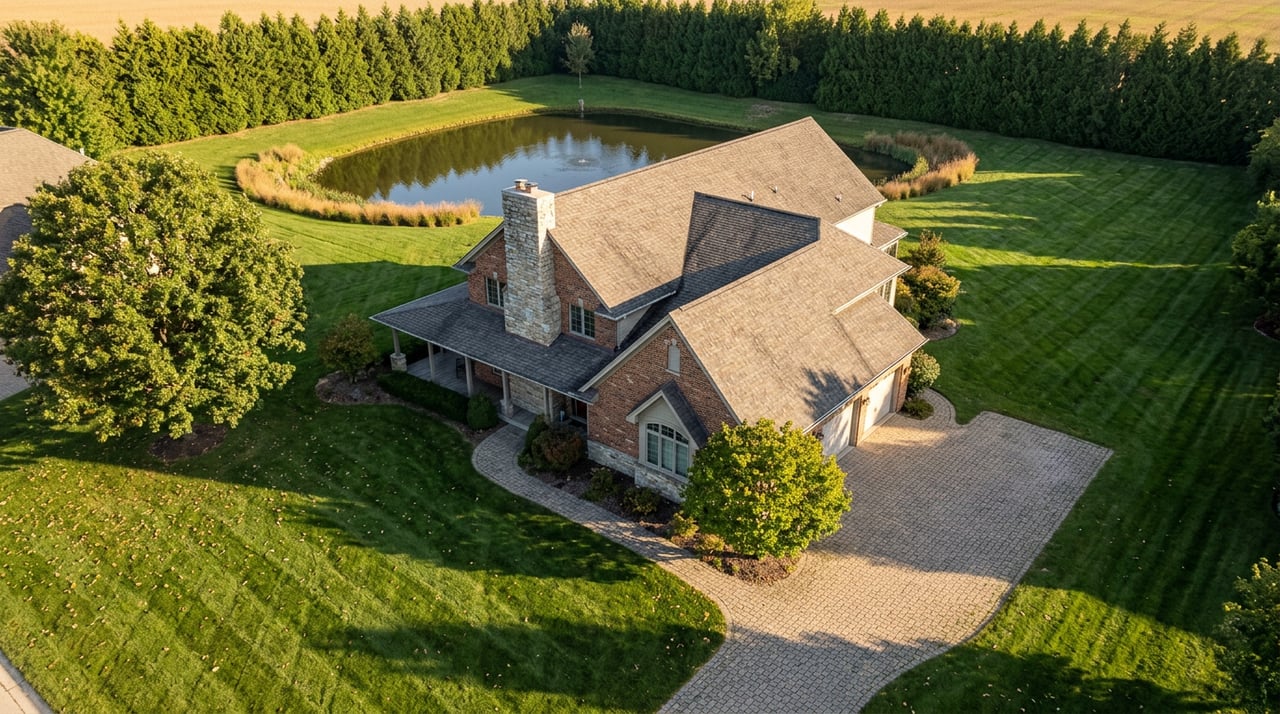
For buyers looking at Blanchard's rural fringe, the number that actually determines what a lot can become isn't square footage. It's acreage relative to Oklahoma's septic rules. Under state DEQ regulations, a lot needs at least half an acre if it's served by public or rural water district service, and at least three-quarters of an acre if the home will rely on a private well. Fall short of that, and a septic system, and therefore a house, may not be permittable at all.
This single rule is a big part of why Blanchard's inventory spans such a wide range. In-town subdivisions like Wolf Creek Estates sit on lots under an acre, close enough to municipal water to clear the smaller threshold easily. Move a few miles out toward the Grady County line, where private wells are common, and the minimum lot size effectively grows. New construction across the wider Blanchard market currently spans from the high $170,000s to nearly $1.5 million, built across more than a hundred communities by dozens of different builders, and that spread tracks the underlying land as much as it tracks square footage or finish level.
Before comparing a Blanchard listing to one in Newcastle or Tuttle, four questions actually change the math:
None of those questions show up in a listing photo. All four show up at closing.
Because Newcastle and Tuttle each sit entirely inside one county, a buyer comparing those two towns is at least comparing one tax office to another, cleanly. Blanchard doesn't offer that convenience. A $330,000 home on municipal water in central Blanchard and a $330,000 home on three acres with a private well near the Grady line are not the same purchase, even though a search filter will show them side by side with identical price tags.
That's not a flaw in Blanchard's market. It's a fact of how the town was drawn, and it rewards a buyer who asks about the county line before they fall in love with a floor plan. The median price everyone quotes for Blanchard is real. It's just an average of two different transactions, and knowing which one you're actually looking at is the difference between a smooth closing and a surprise on the settlement statement.
If you're weighing a move to Blanchard, or trying to make sense of why two listings with the same price tag feel so different once you dig into the details, that's exactly the kind of local groundwork Jill Stephens walks clients through, county line and all. Let's Connect and talk through what a specific address, not just a median, actually means for your move.
Stay up to date on the latest real estate trends.
As a dedicated real estate agent, I'm here to guide you through one of life's most exciting journeys—finding your perfect home. Whether you're buying, selling, or just exploring your options, I'd love to help make your real estate dreams a reality.